
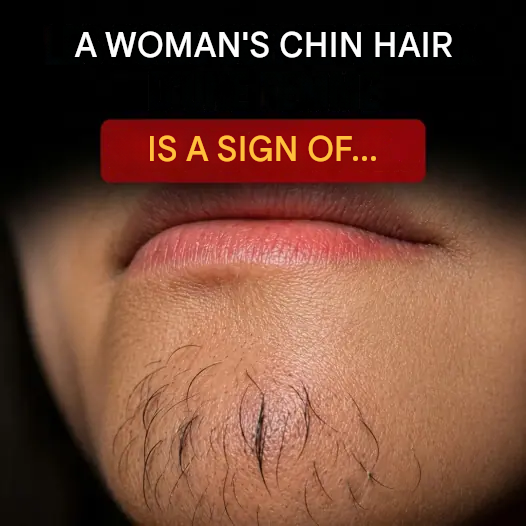
You look at yourself in the mirror one morning, and there—surprise!—a tiny dark hair has appeared on your chin out of nowhere. Your first reaction? A mixture of astonishment and “where did that come from?” Good news: you’re far from alone in experiencing this. And more importantly, this little intruder has a very specific explanation. Your body knows exactly what it’s doing.
Hormones are largely responsible for the situation.

It’s often forgotten, but androgens—those so-called “male” hormones—are also naturally present in the female body. When their levels increase, or when the body becomes more sensitive to their effects, facial hair becomes more visible. The chin is one of the areas most affected.
Puberty, pregnancy, and menopause are major life stages that amplify this phenomenon. During menopause, in particular, the drop in estrogen levels allows androgens to become more prevalent. As a result, some darker and thicker hairs may appear. This is a completely natural evolution of the female body, even if it can be surprising.
Genetics, that factor we don’t choose
If your mother or grandmother had this same minor issue, there’s a good chance you’ll inherit it too. Genetics determines the density and location of hair follicles, just as it determines your eye color or hair texture. Nothing mysterious about it—just your DNA doing its job.
The hair growth cycle: why it seems to appear out of nowhere
Each hair follows a three-stage cycle: growth, rest, and then shedding. Depending on the area of the body, a follicle can remain dormant for several weeks before becoming active. This gives the impression that it has suddenly grown… when in fact it has been discreetly preparing its appearance for a long time.
✨ Did you know? A single follicle can repeat this cycle up to 20 times in a lifetime!
When should you talk to a doctor about it?

In the vast majority of cases, these hairs are completely harmless. However, if their appearance is sudden, abundant, and accompanied by other symptoms such as severe acne or irregular periods, a medical consultation is necessary. This can sometimes indicate a hormonal imbalance, such as polycystic ovary syndrome (PCOS), which is very treatable once diagnosed.
To take care of it without any hang-ups
Tweezing, waxing, laser hair removal… there are plenty of options to get rid of unwanted hair if it bothers you. And rest assured: plucking a hair doesn’t make others grow faster or in greater quantity. The hair simply grows back without its naturally fine tip, which may make it appear slightly thicker—an optical illusion, nothing more.
The key takeaway? Having or not having a hair on your chin says absolutely nothing about your femininity. Your body evolves, adapts, and belongs entirely to you.
Take care of it with kindness, that’s all that really matters.